Pages

Friday, August 3, 2012

Co-Op's, Academics, and, gasp, Being Socialized

BacktoHomeschool


Starting homeschooling can be scary – one thing you always hear is how “unsocialized” homeschoolers are.  In fact, just the other day, I had that conversation with two people at our taekwondo class.  Socialization issues, in my view, are a myth.  In fact, there are so many activities and social opportunities to choose from that academics can get pushed aside if you aren’t careful.


One option is the co-op.  We have found that all co-ops are not created equally.  You have to choose one (or two) that fit your family’s approach to education.  We have run into three different types of co-ops in the last four years. 
1.   The academic co-op with parent teachers –is focused on academics and requires parents to teach at least one class.


2.   The academic co-op with hired instructors –pays instructors to teach students core subjects.  Parents pay tuition.


3.   The loosely academic co-op – offers classes, but they aren’t stringent about the level of participation by students.  This type of co-op typically has parent teachers as well.
Co-ops are not to be confused with social groups.  Co-ops offer classes not just activities.  
We have been blessed to participate in types 1 and 3 of co-ops in our four going on five years of homeschooling. 


Type 1 – Academic Co-op


The second semester of our first year homeschooling, I lucked into being asked to participate in a very academic co-op called the Teen Learning Center.  Their approach is to offer a full schedule of classes one day a week.  Students choose four courses.  We meet at 9:15am and end at 2:00pm.  The focus is on teenagers, but supplementary classes are offered for younger siblings.


This approach fits us to a tee!  We are VERY committed to strong academics.  TLC teachers instruct with rigor and provide a full syllabus and calendar of expectations for students.  Grades are given by teachers.  I’ve had the opportunity to teach Essay & Research, Speech Communication and Computer Programming.  Amazing women attend the co-op; I love getting to take advantage of their expertise in subjects like economics, physics, chemistry, art, etc. Additionally, science labs are offered allowing my boys to investigate science in a group setting.


Membership in the co-op is limited.  We have a committee that governs and ensures everyone is following the rules.  They interview families to make sure they are a good fit for the co-op seeking out parents who can teach courses that have been vacated by graduating families.  TLC currently consists of over 40 families!


In addition to academics, TLC offers a yearbook club and student government.  The student government is for upper-classmen.  They create activities such as special days (crazy hat day, etc.), come up with a few activities (like the annual ski trip), and provide student leadership.  I run the yearbook for now and both my boys participate.  My oldest will also be doing student government this year. 


What I appreciate most about TLC is having my boys in a classroom setting and accountable to someone besides me.  This mirrors what they can expect when they go to college.  Additionally, TLC meets that “socialization” need everyone outside of homeschooling is so worried about.


One thing some might see as a drawback is that we are committed for the duration of the year.  We have to mold our daily routine around the schedule provided by the instructors.  While I’m still the primary teacher for all academics, we have assignments to complete and our pace is set by the classes they take.  Personally, I like this; however, it can be limiting if you want to travel during the year.  TLC runs from September to November and December to May. 


Honestly, it is hard to imagine our homeschooling journey without TLC.


Type 3 – Loosely Academic Co-op


Beginning our first semester of homeschooling, we joined a co-op that was loosely academic.  It is called MASC.  They offered classes like Grossology, American States, Art, etc.  This was a great opportunity for us to meet fellow homeschoolers giving the boys a chance to make friendships and get a break from our daily academics.  We were able to enjoy the classes without feeling pressure to bend our daily schedule around the programs.  Additionally, this co-op offered several outside activities.  It was a good fit our first semester.  Second semester, they changed the timing to mornings, which didn’t work for us so we quit and transitioned to TLC.  This ended up being a great move for us.


We are now back at this co-op in addition to TLC.  At this point, our second co-op also focusses on teens.  My boys participate in Gavel club through MASC.  I can’t say enough good things about Gavel club.  Even if it weren’t part of a co-op, we would be doing Gavel.  Gavel is part of Toastmasters International – it involves public speaking and evaluation.  After delivering ten speeches, the participant earns a certificate.


In addition to Gavel, MASC offers fun classes for the boys.  They will be taking photography and drawing.  I will be teaching basic computer programming using Alice.  More academic offerings like chemistry and SAT Prep are offered as well for additional cost and taught by hired instructors.  This co-op is rife with activities.  Each parent not teaching a class must provide two activities per year.  We are already planning to attend a two-night camping trip that will include a visit to the orchards for fall apple picking.  My youngest loves their filmmaking club and helped act in the first feature film to be screened this week.  He is also a member of their newspaper club honing his writing skills.  Additionally, they have a strong science Olympiad team that we don’t have time to join and a battle of the books team.  (We had our own team last year.)


This co-op is very different from TLC.  It’s about fun activities and enjoying practicing their skills like public speaking, film and writing.  We are blessed to be a part of this co-op as well.  Clearly, socialization is a non-factor.


We meet with this group on Mondays from 12:00pm to 3:00pm.  As this is during our day, we do sometimes have to finish school when the classes are over.


Choosing a Co-Op


Choosing the right co-op for your family is important.  You have to decide what your needs are and then determine which local co-op can meet those needs.  I urge you to test the waters!  Homeschooling all subjects on your own cannot only be a challenge (especially as they hit high school and more difficult subjects), but students benefit from the accountability of another instructor.  One wonderful benefit of the co-op is the opportunity to engage with like-minded parents finding out their methods and sharing yours.  It’s not only our kids that need that “socialization,” homeschooling parents need community as well.

Thursday, August 2, 2012

Comfort School and School on the Run

BacktoHomeschool

Where do we do our homeschooling?   Well…  We homeschool wherever we land. 
Our supplies are kept in “buckets”.  We each have one that houses our books, pencils, papers, etc.  They are kept in my study in a cabinet.  First thing in the morning, we grab our buckets and get rolling.


Kitchen Schooling


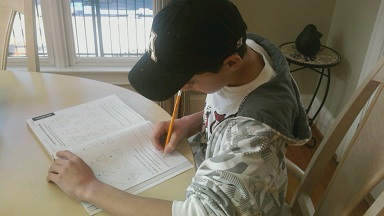
Most days, our homeschooling starts at the kitchen table.  Lots of light, plenty of room, we can all three sit there, and there are outlets for our computers.   When we started, I envisioned me using a whiteboard to provide instruction.  Honestly, I have, but we really don’t need it.  One-on-one doesn’t really require a whiteboard.


Bed Schooling
We’ve done our share of bed schooling as well.  When my boys have something they need to read, they like to retreat to their or my bedroom to get cozy.  My youngest often brings the dog along for good measure.
Another reason to be in mom’s room is if we have a video to watch – the bed is the perfect place to prop up our feet, break out some popcorn and watch a video.


Car Schooling
Yep, we’ve car schooled.  That’s what happens when we have errands or travel during our homeschool day.  If we have to go somewhere during school, they boys bring their required reading for the day and do it during travel time.  No sense wasting time sitting in the car staring out the window when they can be getting something accomplished.


Vacation Schooling
We definitely school when we travel.  Sometimes we take trips intended to be educations.  We saw the Mayan ruins in Mexico when we were studying Ancient History.  Again, we just pack up school and bring it along.


Where do you homeschool?

Wednesday, August 1, 2012

Review - Create Better Writers


Age:  Late Elementary through High School
Cost:  The Home School Writing Action Plan -  $15.95 - ebook, $19.95 - soft cover
          How to Teach the Paragraph - $7.99 ebook (free with Five Paragraph Essay)
          How to Teach the Five Paragraph Essay - $17.95 ebook, $19.95 - soft cover

David Dye taught writing for over twenty years.  He noted a lack of enthusiasm for teaching writing by parents and teachers, and a disdain for the process in students.  His goal was to write a curriculum that made it easy to teach and be taught how to write effectively.

As a member of the Schoolhouse Review Crew, I was sent the e-versions of The Home School Writing Action Plan,  How to Teach the Paragraph, and How to Teach the Five Paragraph Essay.


The Action Plan shows parents the steps to effectively teaching their child how to write.  Included are a Pacing Guide for starting in grades 3, 6 or around high school , and a “Road Map” for teaching writing.  The “Road Map” includes The Paragraph, Sentence Building, Vocabulary, Writing Assessment, Research Report, The Five Paragraph Essay, Narrative Story Writing, and SAT/ACT College Exam Practice.

The action plan is not a full system.  However, it is a sketch of the deeper concepts that should be taught to help students write effectively.  If you know how to write well and are comfortable teaching writing, then this basic guide might be all you need to help you structure your writing program for your children.

Since I teach writing myself, I found that the steps and suggestions are good.  Personally, I don’t think their program has quite enough depth; however, for a reluctant writer whose goal is to produce good basic testing and entry-level college essays, it does teach the foundations.


Strong paragraph writing is the key to strong essay writing.  Too many students start out just putting thoughts on paper without understanding that there is a formula for writing strong paragraphs.  This 23-page e-book helps to illustrate those fundamental components.

The author uses an eleven-step approach. 

Part I – The Basics
Step 1 – Assessment: Students write a paragraph (p. 2)
Step 2 – Learning the five parts of a good paragraph (p. 3)
Step 3 – Memorize the Five Parts of a Paragraph (p. 3)
Step 4 – The Paper Set-Up (p. 4)
Step 5 – Write a Paragraph Together: The Prewrite (p. 6)
Step 6 – Write a Paragraph Together: The Paragraph (p. 7)
Part II – Improving the Parts of a Paragraph
Step 7 – Topic Sentences (p. 9)
Step 8 – Closing Sentences (p. 11)
Step 9 – Paragraph Assessment (p. 13)
Step 10 – Practice, Practice, Practice (p. 13)
Step 11 – The Perfect Paragraph (p. 15)
Appendix A (p. 17) / Appendix B (p. 20)

While this may seem like a lot of steps for a paragraph, it really isn’t.  I appreciate that he has really delineated what the component of a paragraph are and what makes the writing in a paragraph effective.  Topic sentences, strong closing sentences, making sure your word choice is effective are all important aspects of paragraph writing.  For the cost of $7.99, younger students especially would benefit from this approach.


I’m not a huge fan of the five paragraph essay approach for older students.  Students in elementary and early middle school will benefit from the structure that the five paragraph essay provides.  However, this approach can be limiting in terms of depth and creativity.  By the time your student is ready to take the ACT or SAT, and especially before going off to college, he or she should have progressed beyond the limitations of the five paragraph essay.

That being said, the author provides the following steps for approaching the five paragraph essay format:

I. The Steps
1.       Review “What is a Paragraph?” Make sure the students understand that a paragraph is about ONE MAIN IDEA.
2.       Teach the Three-Paragraph Essay in 60 seconds. Start your watch! Ready…Set…Go!
3.       Prewriting Practice for the Three-Paragraph Essay. Creating your Three Main Ideas and listing your supporting details for each.
4.      Introduction Paragraph – Make a thesis statement and give your three main ideas.
5.       Conclusion Paragraph – Summarize your thesis statement, review your three main ideas,and say goodbye.
6.      Putting it All Together
7.      Timed Prompt Writing
8.     Assess and Re-Teach as needed. Put the expert essay writers into “writer’s workshop” activities while working with those who need a little more help.
Bells and Whistles
1. Teach Interesting Introductions
2. Teach Classy Conclusions
3. Teach Terrific Transitions
The Next Level – Tweaking the Essay to Fit All Domains and Genres
1. Narratives
2. Persuasive Essay
3. Problem-Solution Essay
4. Cause and Effect Essay
5. Research Reports

What I really like about this approach is attention to the details.  He makes sure that students understand that the introduction and the conclusion are just as important and must be just as effective as the body of the essay.  Additionally, the Bells and Whistles section does and excellent job of illustrating techniques for really enhancing writing.  This is one of my favorite sections as many students never learn the importance of the intro, the conclusion and especially strong transitions.

This e-book does not fully cover the Domains and Genres section, but it does give a brief overview.  You would have to follow up with your student and cover each of these in addition to other genres like comparison, definition, and process analysis.  Research reports are of greatest value and are not thoroughly covered in either the Action Plan or the Five Paragraph Essay.  For college preparedness, you will want to include these prior to graduation.

Review

Honestly, I feel like this is a good, basic program.  I would use it with elementary or early middle schoolers to really help them understand the process of academic writing.  If you have a very reluctant high schooler, this might be a good approach as well.


To see reviews by other members of the Schoolhouse Review Crew - click here.

***Disclaimer:  I received this product free of charge as a member of the Schoolhouse Review Crew in exchange for my honest opinion.

We Work on Homeschool Time...

BacktoHomeschool

I’m a schedules and tasks kind of person.  In a perfect world, I know what each hour of my day will be spent doing.  So, when homeschooling, it seemed natural, initially, to try to plan out our day by subject area.  8:00 – English, 9:00 – Math… 

Let’s just say, that didn't work so well. 


Planning our Day

What we quickly realized is that homeschooling gives you the freedom to school according to strengths and weaknesses.  It allows timing to be dictated by what it takes to complete the task, not allotting a time for the task.  If the boys get their math done in thirty minutes they move on to the next subject.  If it takes one of them thirty minutes and another an hour, then they each move on when the subject is completed.  There’s no watching the clock.

If we have an activity during the day, then we work up until it’s time to head to that activity.  If we’re not done, then we pick back up where we left off when we get back home until it’s finished. 

Most days – we start at 8:30.  That’s non-negotiable.  However, the day ends when the subjects are completed.  That could be 1:00, 2:00, 3:00…  You get the idea.  No rush.  Just doing our best.  That’s the one stipulation – no rushing, just doing your best!   I check off everything to ensure nothing has been missed.


Planning the Week

As for scheduling what we do during the week, I have a planner for each of the boys.  On Sunday evening, I pull out their backpacks and buckets where we keep their books and look through what needs to be accomplished the next week.  Since we are in a co-op, I make sure all the syllabi are checked to ensure they are on task for those classes as well.  Then, I write out each subject every day and what needs to be accomplished for that day. 

My youngest likes to check it off as he goes.  My older son, who is in 10th grade now, prefers to have some leeway in how he accomplishes his assignments.  He may not get everything in science done that’s listed for Monday, but he may also work ahead in history and complete Tuesday and Wednesday early.  As long as he has everything done in time for co-op and everything else finished by the end of the week, I allow him to manage his own schedule in preparation for college.

By 11th grade, each will be dual enrolling at the local community college.  They have to be able to manage their time and stay on top of multiple schedules.  This is a growth curve that has to happen prior to graduation.

As an online college instructor, I see too many students who are unprepared in the area of time management.

One note, however, is how much we enjoy flexibility.  If a subject requires more in-depth study, I move the schedule to accommodate that time.  If we are moving faster than the schedule is allowing, we increase the speed.  The beauty of homeschool is that we work at the boys’ pace.  Additionally, if we have a field trip on Friday, we can double-up on Monday or even work over the weekend to stay on top of things.

I know some people like to plan much further out.  I have done it in the past.  However, for us, I plan week by week.  I know what has to be done by the end of the year.  The year ends when it’s all done.  If we finish in May – great!  June – great!  You get the idea.  The state requires 180 days – if it takes us longer, that’s fine.  But, we always finish.  As we near the end of our school year, the boys and I sit down and determine what needs to be done to call this year concluded.  Then, they set the pace to get there.  They own it and that makes a big difference for us!

Tuesday, July 31, 2012

Crazy for Curriculum! - The Year in Preview

BacktoHomeschool


I’m one of those “sick” homeschooling moms who drools over the curriculum catalogs each year.  I just love the idea of seeing all the exciting topics I, uh, I mean my boys, will be able to learn about this year.  We are heading into our second year of high school with my middle son and finishing up middle school with my youngest.  It has taken hours and hours of scouring choices and looking at books and pricing options and considering my boys learning styles and figuring out what our co-ops are doing, and, and, and… to get to the point where we made our choices.  So, here they are.

10th Grader (15 this Sept.):

This year he will take three courses through our co-op.  We meet one day a week and then do the learning at home.  I like a co-op because they are accountable to someone besides me, because these ladies have expertise in areas I am weaker in, and because it keeps the idea of a classroom setting in his mind for college.


The three co-op courses are:

Chemistry (and lab)  – we are using Apologia Chemistry.  I am going to incorporate additional work to make it an honors course.  This is really two classes at the co-op because the lab is separate.

American Government and Economics – the instructor has chosen Ray Notgrass’s texts. He’ll use Exploring Government and We Hold These Truths for government first semester and Exploring Economics and Stewardship of God’s Riches for economics second semester. I haven’t worked with Notgrass before, but it was high on my list before the class was formed.

British Literature – this is going to be a rigorous course. The instructor has developed it herself; however, the pacing reminds me of Lightening Lit which we used during the summer (see review – here). He’l l be reading Beowulf, Macbeth, Pride and Prejudice, The Hobbit (In honor of the movie version coming out Dec. 2012), Frankenstein, Jane Eyre, Great Expectations, Silas Marner, and The Hound of the Baskervilles. I’m excited for all he’s going to tackle in this class. We watch the Lord of the Rings trilogy this summer to get ready for the Hobbit.


At home he will be doing:

Spanish II – he is doing this online through the Homeschool Spanish Academy!  We were able to participate in a review for this online course and fell in love with the teachers and the process!  (See review – here.)

Algebra II - Teaching Textbooks is our choice here.  Both my boys really like the format and instruction.  Now that they’ve upgraded the program to include automated grading in addition to video based instruction and explanations for every problem – we’ll stick with this until he dual enrolls at the college.

Sociology  – We are using the CLEP Lesson Plan for Intro to Sociology so that he can take the college CLEP test and earn college credit.  This will be a first semester class.

College Test Prep – This will also be a second semester class.  I want him to be prepared to take the PSAT as a junior in hopes of earning Merit Scholarships as well as the ACT and SAT.  He will be using College Prep Genius for this course.  (See the review – here.)

Fine Arts – He will be doing a hodgepodge of activities to make up his fine arts 1/2 credit.  At another local co-op that we attend, he will be taking both drawing and photography.

8th Grader (13):

My 8th grader also attends the co-ops with his brother.  The three courses he will take at the co-op are:
    
Middle School Art – this class will focus on drawing and paint.


Physical Science – We stick with Apologia for science.  He will be taking a lab with this course as well.

English I – the instructor is using ABeka 9.  She has asked each student to have Themes in Literature, Grammar & Composition III, and Spelling, Vocabulary & Poetry III.  I used Abeka some when I taught middle school and wasn’t in love with it.  However, I’m excited for the level of rigor she is bringing and feel it will be a good course for him to go through since writing is one of his strengths.

At home:

Computer Programming – C# and Game Programming  – we will be using Homeschool Programming.  We’ve used them in the past and have been very happy!  Youngest is big time into computers – I taught a programming course using Alice last year that he excelled in.  He will, in fact, be helping me teach Alice at our second co-op this year.

World History  – we will be using Pearson My World History .  Again, I was blessed with the opportunity to use their product and immediately decided it would be our go-to for world history this year.  (See the review – here.)

Algebra  – Teaching Textbooks all the way!

Logic – The Art of Argument is the curriculum we picked based on another review.  (See the review – here.)  Youngest loves to argue…  lol.  I think he’ll enjoying learning the different fallacy types, etc. 

Photography – He will take this class with his brother.  He loves filmmaking and enjoys several aspects of photography.  This will be fun!

Whew – that’s one big year ahead of us and that’s not even counting the extra-curriculars…  I can’t wait to get past the anticipation and finally get rolling!  


Monday, July 30, 2012

Homeschooling Methods - We're an Eclectic Bunch

BacktoHomeschool

When we first decided to homeschool my head was spinning with all the terminology.  It wasn’t as easy as picking out our textbooks and doing school at home.  There was SO much more to it – so much more than I could have possible anticipated.
We decided in June or July we would be homeschooling come the end of August.  Yikes!  I surfed and surfed and looked and looked to find what would be “right” for our family.  I tried to read as many books as I could in that short period of time and absorb what I could.  How do I pick a method?
Well, we are now four years into it, starting our fifth year, and all those methods, I discovered, are just guidelines.  You don’t get locked into one philosophy or the next when you start.  I like something about every method out there, bits and pieces of each work for us.  So, we are labeled Eclectic.
Unit Studies is where we started.  I liked having everything integrated.  What we studied in history we pulled over into science and literature.  It kept things cohesive and helped me figure out what was working and what wasn’t.  We’ve done Latin and literature ala Charlotte Mason.  Latin being terrific for vocabulary and SAT’s down the road, and literature is a wonderful way to understand history in a fictional setting. 
Now, with my oldest doing high school and my youngest finishing middle school – we combine the methods even more.  We use online classes, video based classes, textbooks and experiential learning.  I’ve discovered as I’ve schooled my boys what approach works best for each subject.  I’ve learned what they are more willing to learn from someone besides me and what I can handle. 
We love our co-ops!  Not because they do the classes for us, but because they add structure.  We are definitely a structure kind of family.  I would say we leave our unschooling for summer and follow structure during the “school year”.  Co-ops, I’ve found, add a level of accountability that my boys wouldn’t have just by doing work at home.  They aren’t just answering to me!  (Read more about this on Friday!)
If you’re new to homeschooling, don’t panic over what METHOD you will use.  Instead, spend time discovering what approach fits your children, your family best.  If you are combining ages, that will be different than if you are separating them or homeschooling one age range.  There’s no locked in!  You can change mid-year or mid-week, or you might find one method works for your entire homeschooling journey.  It’s what works for you! 

Saturday, July 28, 2012

Calling All Dog Lovers - Gund Top Dog Contest

 
I know a lot of you are big fans of your favorite pooch. I know my hubby is crazy about our deaf Boston Terrier, Daisy. So I thought you'd appreciate hearing about this fun contest by GUND.
GUND is asking dog lovers to submit photos of their furry friends in four categories to the GUND Facebook page. Categories are:

• Most Beautiful Dog
• Ugliest Dog
• “Doganista”/Best Dressed Dog
• Dog that Most Resembles its Owner

Owners can enter one or all of the categories! To go straight to the entry form - click here.

What do you win?

If you win the Grand Prize -your perfect pooch's likeness will be transformed into a limited edition GUND plush! How cute is that?
Entries are being accepted from July 16 to August 15, 2012. Winners will be chosen the week of August 20th and announced the week of August 27th.

Pinterest!
In addition to their Facebook contest, they are also hosting a "Most Pinteresting Dog" contest via Pinterest. Simply post your pooch on your own Pinterest page, tag @GUNDMostPinterestingDog and submit that link to GUND at MostPinterestingDog@GUND.com.
The pinned pooch with the most likes will receive $250 in GUND products!

For complete rules - see "Top Dog" Contest and "Most Pinteresting Dog" Contest at www.GUND.com .


*** Disclaimer: I'm providing you this information as a member of Child's Play Communications.